

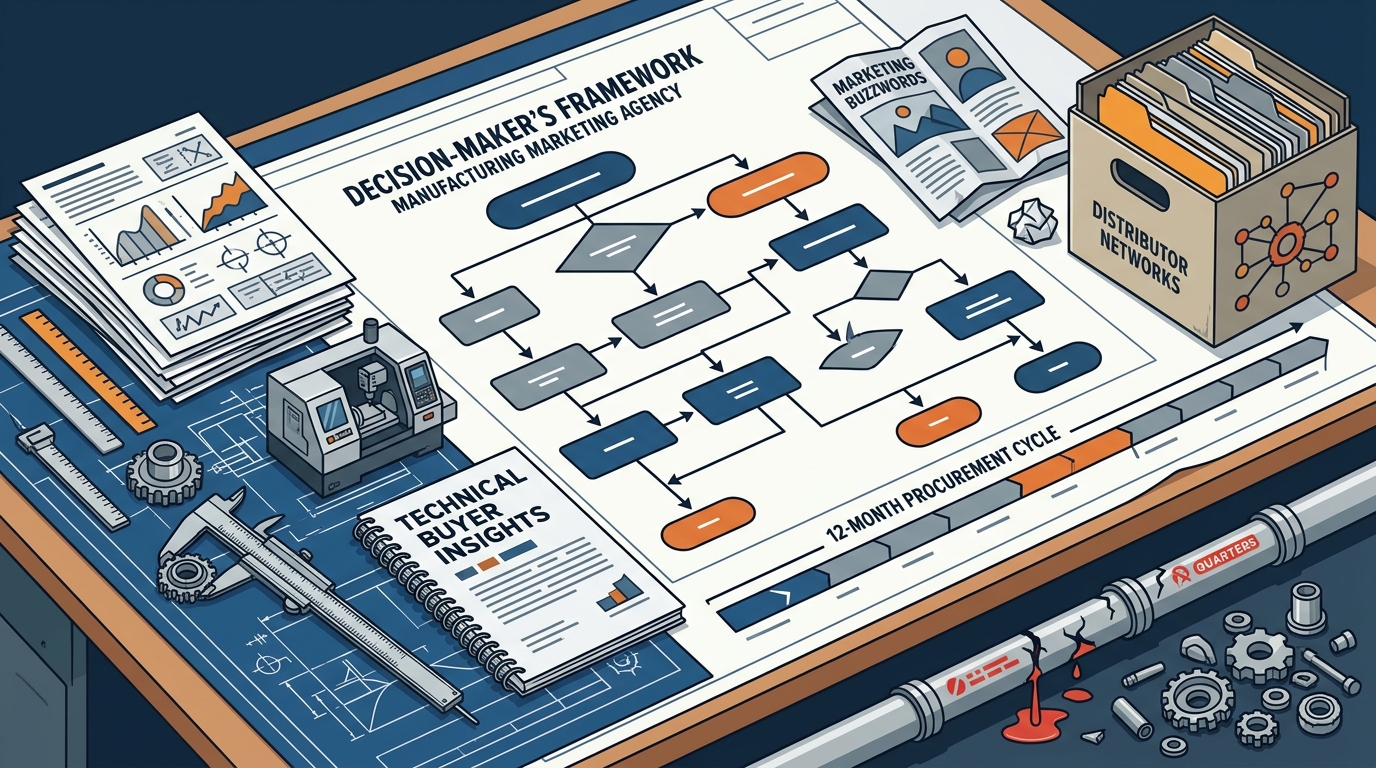
Manufacturing companies operate in a world that most marketing agencies never see — technical buyers comparing spec sheets, 12-month procurement cycles, multi-stakeholder buying committees, and distributor networks that add layers of complexity to every campaign. Choosing the wrong marketing partner doesn't just waste budget; it sets your pipeline back quarters.
This guide provides a structured framework for evaluating whether a specialized manufacturing marketing agency is the right move for your business — and what to expect when you make that shift.
The Core Problem: Why Generalist Agencies Struggle with Manufacturing
Manufacturing marketing differs fundamentally from consumer or even standard B2B marketing. Your buyers are engineers who want specifications on complex, technical products that need skilled explanation. A generalist agency that doesn't understand the difference between machining and fabrication will produce content that falls flat with this audience.
The nuances extend beyond messaging. Manufacturing companies must navigate regulatory considerations, distributor coordination, and buying journeys that span months. Assessing marketing ROI is notoriously difficult in B2B manufacturing, particularly in industries with lengthy sales cycles and intricate user journeys. These realities demand a partner with firsthand sector experience.
Framework: Six Strategic Advantages of a Specialized Manufacturing Partner
1. Faster Ramp-Up and Reduced Risk of Shallow Messaging
Specialists shorten ramp time and reduce the risk of superficial messaging. The best manufacturing agencies hire writers and strategists who can interpret specs, compliance, and distributor needs. Compare this with a generalist agency that may require months of education about your products before producing anything useful — time your competitors are using to capture market share.
2. Content That Converts Technical Buyers
Manufacturing marketing agencies excel at translating complex technical products and services into compelling digital narratives and optimized strategies. Instead of generic blog posts targeting broad keywords, a specialized partner creates application-specific landing pages, comparison guides for engineers, and technical white papers that address real procurement questions.
Consider the structure of effective manufacturing content: high-intent landing pages for specific applications and industries, improved navigation and internal linking, clearer conversion paths such as RFQ forms, quote requests, and spec downloads, plus content structured for both search engines and AI answer engines.
3. Lead Quality Over Lead Volume
Manufacturers don't need more traffic — they need better leads. A specialized agency understands that a single qualified RFQ from a procurement manager at a target OEM is worth more than a thousand generic website visits. They build strategies around qualified RFQs, demo requests, and lead velocity — the metrics that actually grow revenue.
This extends to how leads are captured. Custom sites help manufacturers stand out with features like interactive product catalogs, user-friendly RFQ forms, and secure distributor portals — all built to engage technical audiences and support complex buying journeys.
4. Channel and Distributor Strategy Built In
Most manufacturers don't sell direct. They work through distributors, reps, and channel partners. A specialized agency can design distributor portals and enablement tools so partners can access content, specs, pricing, and marketing assets. They also build pages and conversion paths that support early-stage research and align CTAs for distributor routing, 'where to buy' flows, and OEM inquiry paths so the website supports your channel strategy.
5. Scalability Without Overhead
Outsourcing marketing to an agency saves small- to medium-sized manufacturing businesses time and resources. It eliminates the need for recruiting, training, managing an in-house team, and investing in marketing tools and software. Marketing agencies offer scalability, allowing you to adjust marketing efforts based on your business's needs — ramping up quickly during product launches or peak seasons and scaling back when appropriate.
This is especially valuable when margins are tight. Tariffs, labor prices, and material shortages are driving up costs across the sector, and marketing is frequently the first area to be cut when budgets compress. Partnering with a specialized agency lets you invest in smarter, measurable campaigns rather than absorbing the fixed costs of a full internal department.
6. AI-Era Visibility and Modern Search Strategy
The search landscape has changed. Buyers now discover suppliers through Google, AI assistants like ChatGPT and Perplexity, and industry-specific platforms. A manufacturing-focused agency stays ahead of these shifts, optimizing for complex, niche search queries — covering long-tail keywords, feature-based searches, integration queries, and vertical use cases.
Modern manufacturing SEO goes beyond traditional rankings. It includes content structured for AI citation, semantic HTML for answer-engine discoverability, and page architecture designed so that when a procurement engineer asks an AI tool for supplier recommendations, your company appears in the response.
What to Look For: Evaluation Criteria for Choosing an Agency
Not all agencies that claim manufacturing expertise deliver it. Use this checklist when evaluating potential partners:
- Client portfolio depth: Look for case studies with manufacturers, OEMs, or industrial distributors — not just B2B SaaS companies.
- Technical content capability: Can they discuss your products intelligently? An agency that cannot distinguish between your product categories will struggle to generate qualified leads.
- Sales cycle awareness: Most manufacturing companies have long lead times where instant ROI is unlikely. Your agency should set early indicators of success — organic visibility gains, account targeting accuracy, and brand awareness metrics — rather than promising quick wins.
- CRM and automation integration: The agency should connect your site to CRM systems and marketing automation tools so you can track engagement, capture qualified leads, and streamline your sales process.
- Channel marketing support: If you sell through distributors, your agency needs experience building enablement tools and co-marketing programs, not just direct-response campaigns.
Real-World Scenario: The Cost of Getting It Wrong
Imagine you hire a generalist agency. They redesign your site with beautiful visuals but bury your RFQ form three clicks deep. They target high-volume keywords like 'custom parts' instead of long-tail terms your actual buyers use, such as 'ISO 13485 medical device contract manufacturer Southeast US.' Traffic increases, but your sales team reports that leads are unqualified — students, hobbyists, and companies outside your target verticals.
Now contrast that with a specialized partner. They start with deep research into your audience, competitors, and industry trends. They build application-specific pages that rank for the exact terms procurement teams search. They structure conversion paths for different buyer personas — the engineer evaluating specs, the operations manager comparing total cost of ownership, and the procurement lead ready to request a quote. Within six months, contact form submissions increase, and more importantly, the leads match your ideal customer profile.
When a Specialized Agency Is Not the Right Fit
Transparency matters. A specialized manufacturing agency may not be ideal if:
- Your company sells commodity products primarily on price — a PPC-only approach may be more efficient.
- You have a mature, well-staffed internal marketing department that only needs tactical execution on isolated projects.
- Your budget cannot support a minimum 6-month engagement — manufacturing marketing compounds over time and short sprints rarely produce meaningful results.
Key Takeaways
- Generalist agencies lack the technical fluency needed to create content that resonates with engineers, procurement teams, and industrial buyers.
- Specialized agencies reduce ramp-up time, produce higher-quality leads, and build strategies around revenue metrics like RFQs and lead velocity rather than vanity traffic.
- Channel and distributor support is a critical differentiator — most manufacturers need an agency that can build enablement tools, not just awareness campaigns.
- Modern manufacturing SEO must account for AI answer engines, long-tail technical queries, and structured content that earns citations across search platforms.
- Evaluate agencies on portfolio depth, technical literacy, sales cycle understanding, and CRM integration capability — not just design quality or traffic promises.
Frequently Asked Questions
What makes a manufacturing marketing agency different from a general B2B agency?
A manufacturing-focused agency employs writers and strategists who can interpret technical specifications, compliance requirements, and distributor needs. They understand the nuances of products that require skilled, technical explanation and can reach hard-to-access decision-makers — from procurement teams at multinational manufacturers to engineers specifying solutions for next-gen production lines.
How long before a manufacturing marketing agency delivers measurable results?
Most manufacturing companies have long lead times where instant marketing ROI is unlikely. Within the first six months, look for early indicators like increases in organic visibility, stronger account targeting, and improved brand awareness metrics. Pipeline-level revenue impact typically compounds over 9–18 months as content authority builds.
Is it more cost-effective to hire a manufacturing marketing agency or build an in-house team?
For small to mid-sized manufacturers, outsourcing to an agency saves time and resources by eliminating the need for recruiting, training, providing benefits, and investing in marketing tools. Agencies also offer scalability — they can ramp up during product launches and scale back when needed — providing flexibility that fixed internal teams cannot match.
Can a specialized agency work alongside our existing internal marketing team?
Absolutely. Many specialized agencies are designed to plug into what you're already doing. They build landing pages that support your sales initiatives, trade show campaigns, distributor programs, and existing content while ensuring your SEO structure aligns with your broader strategy.
What services should a manufacturing marketing agency provide?
Core capabilities include SEO tailored to technical and niche search queries, conversion-focused web design with RFQ forms and distributor portals, content marketing that translates complex products into buyer-ready narratives, PPC structured for B2B cycles, CRM integration, and marketing automation for lead tracking and qualification.