

How to Optimize Your Website for Search Engines and Attract More B2B Leads
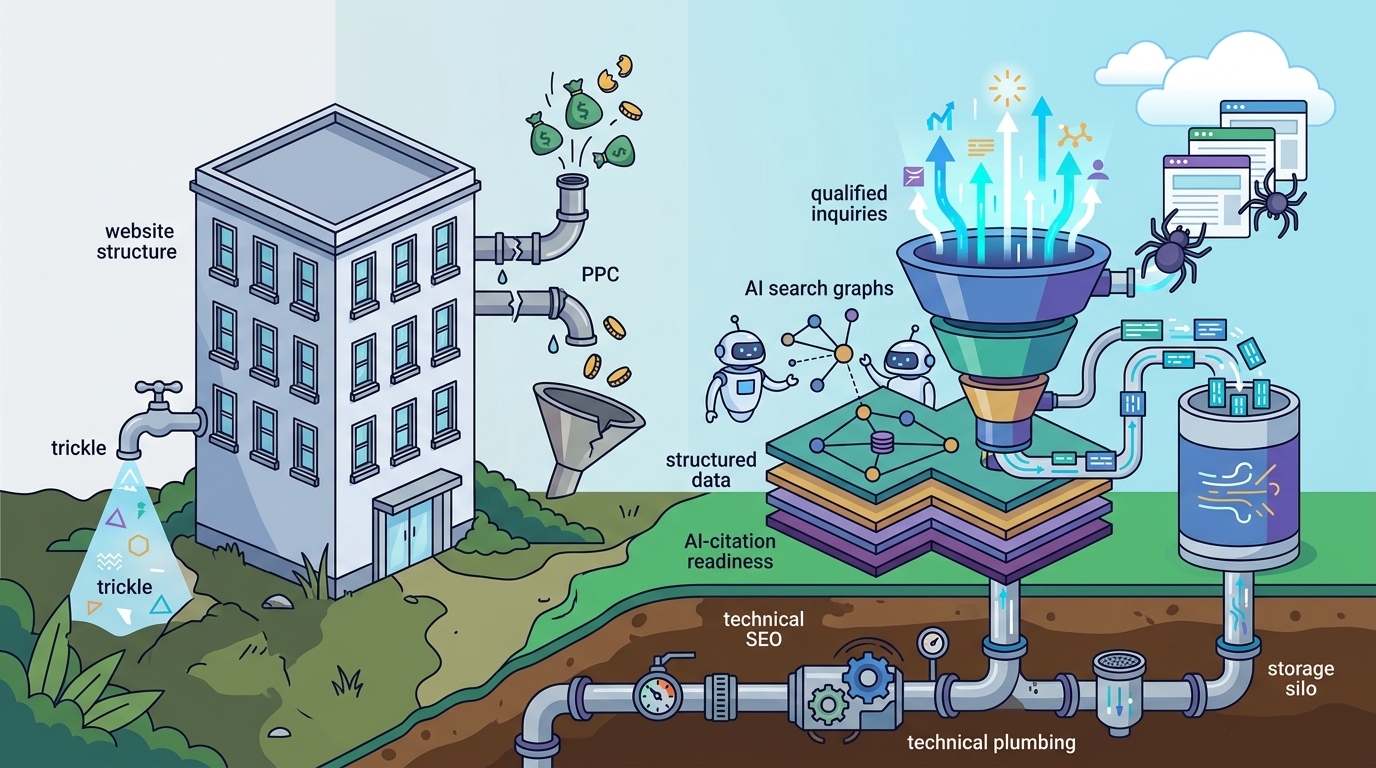
If your website looks polished but generates barely a trickle of qualified inquiries, the issue likely isn't design—it's discoverability. In 2026, the way B2B buyers find vendors has fundamentally changed, and your SEO architecture needs to change with it. This guide walks through every layer of optimization—from technical plumbing to AI-citation readiness—so your site becomes a consistent pipeline engine rather than a static brochure.
Why SEO Is the Highest-Leverage Channel for B2B Pipeline
Paid campaigns deliver instant traffic, but the moment you pause spending, leads disappear. SEO works differently. Organic search visibility compounds over time, creating a durable asset that keeps generating inquiries month after month. According to recent benchmarks, average B2B SEO ROI is 756 percent compared to 362 percent for paid search, often delivering a 12.6× return on investment. SEO-generated leads also close at 14.6 percent—1.7× higher than outbound leads—because searchers are actively seeking solutions rather than responding to interruption.
Nearly 60 percent of B2B businesses report that SEO has the biggest impact on their lead generation efforts, yet many companies still under-invest in it. The opportunity is wide open for businesses willing to approach SEO as a strategic discipline rather than a checkbox.
Step 1: Build Your Ideal Customer Profile Before Touching a Keyword Tool
Every effective B2B SEO campaign begins with clarity about who you're trying to reach. Before you research a single keyword, document your Ideal Customer Profile (ICP)—the industries, company sizes, job titles, and pain points that define your best-fit buyer.
Map their journey across four stages: Awareness, Interest, Consideration, and Decision. Each stage has its own keyword opportunities and content requirements, ensuring your SEO targets buyers at the right moment. A procurement director searching "what is design-build project delivery" is in a fundamentally different mindset from one searching "web design agency for manufacturing companies"—and your site needs content for both.
Step 2: Conduct Intent-Driven Keyword Research
B2B keyword research operates on a different logic than B2C. While consumer brands chase high-volume generic terms, B2B focuses on long-tail keywords with high commercial intent. A term like "enterprise data migration solutions for healthcare" might only generate 20 monthly searches, but each potential lead could represent a six- or seven-figure contract.
Prioritize Bottom-of-Funnel Terms
The most valuable B2B keywords are those decision-makers search when they're ready to purchase. Think "custom website design for logistics companies" or "UX audit for SaaS platform." These terms signal buying intent, not casual browsing. Use tools like SEMrush, Ahrefs, or AI-assisted keyword generators to identify terms with strong CPC relevance even when search volumes look modest.
Don't Ignore Top-of-Funnel Content
Awareness-stage topics still matter. They drive traffic, establish authority, and nurture leads over time. The key is to ensure every page serves a strategic role in guiding a prospect toward conversion rather than existing as orphaned content with no path forward.
Step 3: Nail On-Page SEO for Every Key Page
On-page optimization in B2B goes beyond sprinkling keywords. It's about creating value-driven, informative content that answers your target audience's questions and solves their problems. Here's a practical checklist for every important page on your site:
- Title tags: Include your primary keyword and make them compelling enough to earn the click in search results. A title tag is the first impression your site makes, and it directly influences click-through rates.
- Meta descriptions: Write unique descriptions for every URL. Treat them as micro-ads that pre-qualify visitors.
- Header hierarchy: Use H2 and H3 tags to create a clear content structure that both humans and crawlers can parse.
- Alt text on images: Describe every image meaningfully. Search engines rely on alt text to understand visual content.
- Internal links: Link related pages together. Internal links distribute page authority throughout your site and help search engines understand topic relationships. Proper internal linking spreads page authority two to three times more effectively than leaving pages isolated.
Step 4: Ensure Your Technical Foundation Is Solid
Behind every high-performing B2B SEO strategy is a technically sound website. If your site is slow, hard to navigate, or not mobile-friendly, your rankings and conversions will suffer. Here's what to audit:
- Page speed: Use a content delivery network, compress images, and remove unnecessary scripts. Slow-loading websites signal poor quality to search engines.
- Mobile optimization: 68 percent of B2B researchers use mobile for product searches in early buying stages. Don't ignore this audience.
- Clean URL structure: Search engines can easily contextualize a page when the URL describes what it's about. Keep URLs short, descriptive, and human-readable.
- XML sitemap: Create one and submit it to Google Search Console so search engines can find and index your pages efficiently.
- Structured data (schema): Use schema markup to give context to your content and qualify for featured snippets or rich results. Only 10–15 percent of B2B sites implement schema comprehensively, representing a significant competitive advantage for those who do.
- Fix broken links and redirect chains: These confuse both users and search engines, degrading trust and crawl efficiency.
Step 5: Create Content That Earns Authority and Backlinks
Content is where your expertise becomes visible. In B2B, purchases are seldom driven by impulse, so every article, case study, or whitepaper represents an opportunity to demonstrate knowledge and build trust with future buyers.
Build Content Clusters, Not Random Blog Posts
Organize content around core topics your business owns. A web design agency, for example, might build clusters around "B2B website redesign," "UX for enterprise platforms," and "conversion rate optimization." Each cluster includes a comprehensive pillar page supported by related articles that link back to it. This structure improves rankings while supporting the natural B2B research process.
Publish Less, But With Higher Impact
In an ecosystem saturated with AI-generated content, the winners will not be the brands that publish the most content, but those that demonstrate real expertise and proven authority. Every article should include original data, unique perspectives from your team's actual project experience, and specific examples that competitors can't replicate.
Invest in Off-Site Authority
Guest blogging on reputable sites expands your brand awareness and provides high-quality backlinks. When other sites link to your content, they essentially endorse your expertise. Focus on sites with strong domain authority—quality always outperforms quantity in backlink building.
Step 6: Optimize for AI Search and Generative Engines
This is the layer most B2B companies are missing entirely. In 2026, AI Overviews, Perplexity, and ChatGPT Search now mediate the majority of complex B2B searches. Your content must be structured to win citations in these environments.
Write for Extraction
Structure content for direct answers and create short, authoritative blocks that feed SERP features. Every key concept should get a standalone one-to-two sentence definition that AI can extract independently. Include numbered processes, comparison tables, and passage-level answers—self-contained 40–60 word responses to specific questions.
Add FAQ JSON-LD
Produce API-friendly FAQ structured data that AI systems can parse. This serves double duty: it qualifies you for FAQ rich results in traditional search while also making your content more citable by large language models.
The Quality Payoff
Visitors from AI citations are 4.4× more qualified than standard search traffic. Traffic volume may decline in the AI era, but traffic quality increases dramatically for organizations that optimize for citation. GEO (Generative Engine Optimization) techniques have been shown to improve visibility in generative engines by approximately 40 percent.
Step 7: Connect SEO to Your CRM and Measure Pipeline Impact
The most common reason B2B companies under-invest in SEO is that they can't prove its revenue impact. Fix this by connecting organic sessions to your CRM so every lead has a source.
- Implement GA4 measurement for sessions, leads, and sales-qualified leads (SQLs).
- Add UTM hygiene and server-side capture so attribution is clean and consistent.
- Ensure every web form fires events that feed your CRM. No measurement means no attribution. No attribution means no proof that SEO generates leads.
- Track pipeline metrics like MQLs, SQLs, and pipeline influenced by organic—not just traffic and rankings. Use goals that reflect pipeline influence rather than last-touch attribution only.
Marketing automation and CRM integration are essential for proving SEO lead generation ROI. When you can show that organic search influenced a specific percentage of closed deals, budget conversations become straightforward.
Step 8: Refresh and Update Existing Content Regularly
Old content updates are one of the most underrated lead generation SEO strategies. Review and refresh your existing pages at least once a year. Rewrite obsolete sections, update statistics, add new examples, and strengthen internal links. Monitoring Google Search Console regularly helps you identify pages ranking on page two that could be pushed higher with additional detail and optimization. SEO isn't something you set up once and forget—it requires ongoing refinement.
Key Takeaways
- B2B SEO targets decision-makers, not mass audiences. Low-volume, high-intent keywords often deliver the greatest revenue impact.
- Technical SEO—speed, mobile-friendliness, schema, clean URLs—is the non-negotiable foundation everything else depends on.
- Content clusters organized by buyer journey stage outperform random blog posts. Publish fewer pieces with greater depth and originality.
- Optimizing for AI citation is no longer optional. Structure content in extractable blocks with FAQ schema to earn visibility in generative search engines.
- Connect organic traffic to CRM pipeline data. Prove ROI by tracking influenced opportunities and revenue, not just sessions and rankings.
- Refresh existing content annually. Pages that once performed well can regain traffic with updated data and improved optimization.
Frequently Asked Questions
How long does B2B SEO take to produce results?
B2B SEO requires patience. Expect 6–12 months for top-3 rankings on competitive terms and 12–18 months for sustained 20–30 percent traffic growth. However, with proper measurement infrastructure, you can see initial ROI visibility within 2–3 months by tracking leading indicators like keyword position improvements and organic lead volume.
What makes B2B keyword research different from B2C?
B2B keyword research focuses on long-tail terms with high commercial intent rather than high-volume generic phrases. A term searched by only 50 people per month can be extremely valuable if those 50 represent qualified buyers evaluating solutions in your space.
How important is technical SEO for generating B2B leads?
Critical. If your site is slow, produces indexing errors, or lacks mobile optimization, no amount of great content will rank. Technical SEO ensures that search engines can crawl, understand, and confidently recommend your pages—and that visitors have a smooth experience once they arrive.
Should I optimize for AI search engines like ChatGPT and Perplexity?
Yes. In 2026, a significant portion of B2B searches are mediated by AI tools. Visitors who arrive via AI citations are substantially more qualified than standard organic traffic. Structuring content with standalone definitions, FAQ schema, and comparison tables makes your pages more likely to be cited.
How do I prove the ROI of B2B SEO to leadership?
Connect your organic search analytics to your CRM. Track metrics like organic-influenced pipeline, cost per acquisition from SEO versus paid channels, and lifetime value of organic-sourced customer cohorts. When you can tie specific revenue to organic search, the investment case becomes clear.
What role does a design agency play in B2B SEO?
A design agency like Synchronicity Designs can ensure your website's architecture, page speed, navigation hierarchy, and visual layout all support SEO performance. Great design and strong SEO aren't competing priorities—they're complementary layers that together create a site capable of attracting, engaging, and converting B2B buyers.