

Manufacturing companies have spent decades investing in production-floor technology while their marketing and sales capabilities lagged behind. That imbalance is now a competitive liability. Industrial buyers have fundamentally changed how they evaluate and select suppliers, and manufacturers that fail to meet them digitally are being quietly eliminated from consideration.
This guide breaks down the strategies that generate real pipeline for manufacturers — not theoretical frameworks, but the specific channels, tactics, and sequencing that turn digital visibility into qualified opportunities.
The Shift: Why Digital Marketing Is No Longer Optional for Manufacturers
The old playbook — trade shows, cold calls, and PDF catalogues — no longer carries the weight it once did. Industrial buying behavior has undergone a permanent transformation.
74% of B2B customers now complete at least 57% of their purchasing process online before engaging with a sales representative. Procurement managers research vendors, compare specifications, and build shortlists entirely through digital channels before a single conversation takes place.
Meanwhile, 67% of manufacturing marketers still rate their content strategy as only moderately effective. The gap is not about spending more — it is about spending smarter. Manufacturers that align their digital presence with how modern industrial buyers actually evaluate suppliers will capture disproportionate market share.
B2B manufacturing marketing differs from other sectors because of the extreme technical sophistication of buyers, the length and complexity of sales cycles spanning 12–18 months, and the physical nature of products being sold. What works for SaaS or professional services falls flat when you are selling six-figure equipment to committees of engineers who scrutinize every specification.
Strategy 1: Technical SEO Built Around Buyer Intent
Search engine optimization remains the foundation of any sustainable digital marketing program for manufacturers. Google still accounts for 81% of all search traffic worldwide, and traditional search remains a core channel for B2B businesses looking to capture market share and drive lead generation.
However, manufacturing SEO requires a fundamentally different approach than consumer or even general B2B optimization:
- Target technical long-tail keywords. Engineers and procurement professionals search with high specificity — think "corrosion-resistant alloy flanges ASTM A182 F316" rather than "metal parts supplier." Map your keyword strategy to the actual language your buyers use when evaluating solutions.
- Prioritize E-E-A-T principles. Google's algorithm increasingly prioritizes experience, expertise, authoritativeness, and trustworthiness. For manufacturers, this means publishing content authored or reviewed by real engineers, including credentials, and backing claims with data sheets and certifications.
- Optimize for AI search surfaces. With AI overviews reshaping how search results are displayed, your content must provide clear, structured answers that both traditional crawlers and large language models can parse and cite.
- Fix your technical foundation. Intuitive navigation, responsive design, and fast-loading times are table stakes. A manufacturing website that takes five seconds to load or buries critical spec information three clicks deep is losing prospects silently.
For competitive manufacturing categories, meaningful SEO improvements typically take 4 to 6 months. Less contested niches can see movement earlier, but the compounding effect of consistent technical content investment is what separates leaders from laggards.
Strategy 2: LinkedIn as Your Primary Social Channel
LinkedIn is the most direct route to B2B decision-makers. Unlike other social platforms, it allows you to reach the exact procurement managers, engineers, and plant directors who influence purchasing committees.
Effective LinkedIn strategies for manufacturers go beyond occasional company updates:
- Targeted advertising by job title and industry. LinkedIn's ad platform lets you reach specific roles — VP of Operations at automotive OEMs, for example — with messaging tailored to their evaluation criteria.
- Thought leadership from subject-matter experts. Buyers check your LinkedIn presence before agreeing to meetings. Personal profiles of your engineers and sales leaders should showcase expertise, not just corporate messaging.
- Authentic content over polished campaigns. The trend in B2B social media is shifting away from overly produced brand content toward authentic content that communicates what the business stands for without explicitly presenting a sales pitch.
Strategy 3: Google Ads for Capturing High-Intent Demand
PPC will continue to drive leads in 2026 and is not going anywhere. For manufacturers, Google Ads delivers faster results against high-intent search queries that indicate a buyer is actively evaluating suppliers.
The key distinction for manufacturing PPC is building campaigns that map to how industrial buyers actually evaluate suppliers — with proper retargeting across platforms through long evaluation cycles, not just capturing a single click.
Critical PPC considerations for manufacturers:
- Bid on high-intent specification terms rather than generic industry keywords
- Use retargeting to stay visible across the 6–18 month evaluation window
- Create landing pages with technical depth — spec sheets, tolerance data, certification badges — not generic marketing copy
- Track cost per qualified lead and marketing-sourced revenue, not just click-through rates
Google is leveraging AI to better understand user intent and deliver ads to the most relevant users for a given search. Manufacturers who adopt AI-driven bid strategies and audience targeting will outperform those running static campaigns.
Strategy 4: Content Marketing That Builds Technical Authority
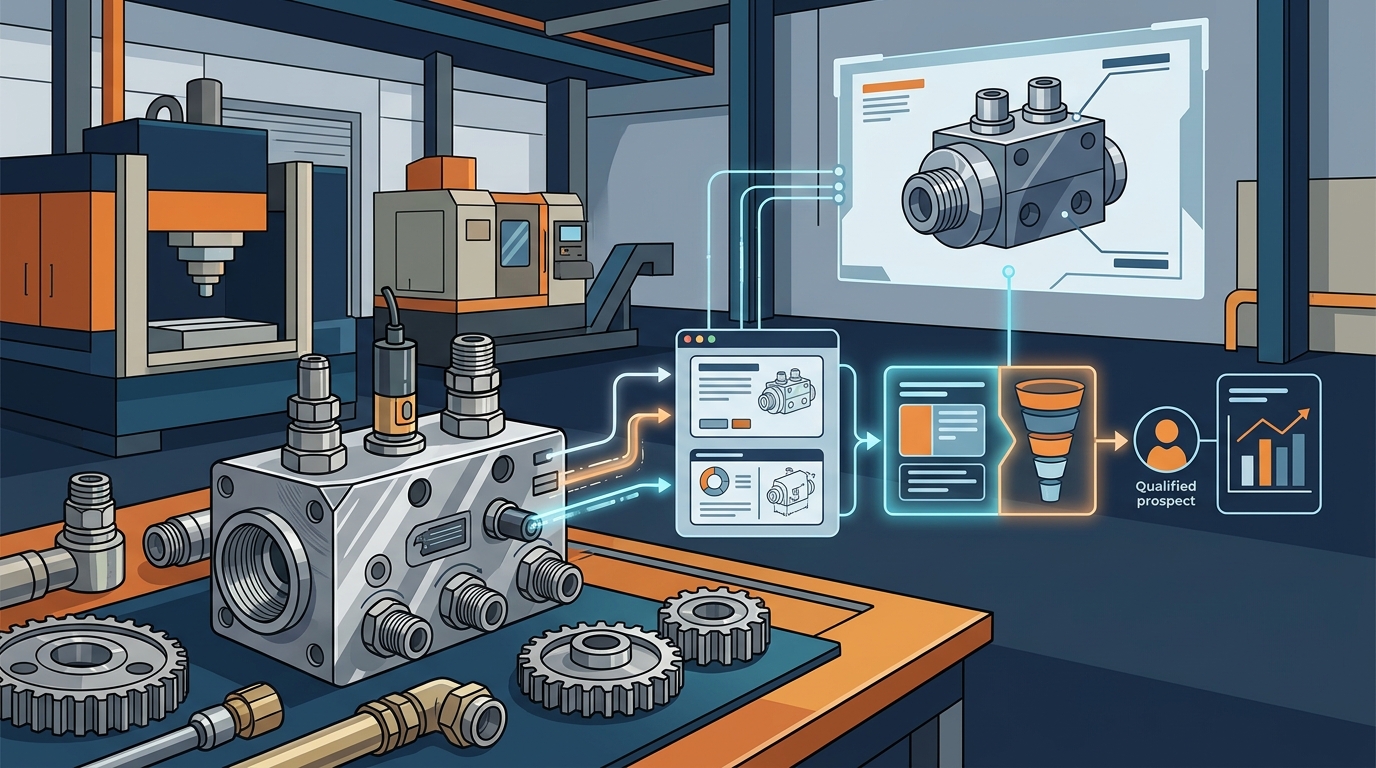
Content marketing in manufacturing is not about blog volume — it is about building a technical authority library that compresses the trust-building phase of your sales cycle.
Industrial buyers complete the majority of their research before a vendor even knows they are in the market. If your website does not answer what a procurement manager is looking for, you are being quietly ruled out — no rejection, no feedback. The buyer simply moves to someone who shows up.
High-impact content formats for manufacturers:
- Technical white papers and application guides that demonstrate deep domain expertise
- Case studies with measurable outcomes — tonnage produced, tolerances held, lead times reduced
- Comparison content that helps buyers evaluate material choices, process tradeoffs, or compliance requirements
- Video walkthroughs of production capabilities, quality processes, and facility tours
- Interactive tools such as ROI calculators, product configurators, and diagnostic assessments
Eight in ten B2B decision-makers will actively look for a new vendor if performance guarantees are not offered. Your content must provide the technical proof that buying committees require to justify their decision.
Strategy 5: Marketing Automation for Long Sales Cycles
Manufacturing sales cycles are long — shortlisting, internal approvals, technical evaluation, and procurement negotiation can stretch across many months. Marketing automation bridges the gap between initial interest and sales-ready engagement.
Effective automation for manufacturers includes:
- Lead scoring based on content engagement, specification downloads, and repeat visits to high-intent pages
- Nurture sequences tailored to different buying committee roles — the engineer cares about tolerances, the CFO cares about total cost of ownership, the procurement lead cares about supply chain reliability
- Sales and marketing alignment through shared dashboards and coordinated handoff protocols
Coordinated sales and marketing efforts create predictable lead flow, shorten sales cycles, and increase conversion rates. The technology exists to do this at scale — the challenge for most manufacturers is organizational commitment to implementation.
Strategy 6: Account-Based Marketing for High-Value Targets
For manufacturers pursuing a defined set of target accounts — major OEMs, Tier 1 suppliers, or key distributors — account-based marketing (ABM) concentrates resources where they generate the highest return.
In 2026, ABM programs for manufacturers are becoming more sophisticated through predictive analytics that identify in-market buyers before they fill out a form. AI-powered segmentation now blends firmographic, technographic, and intent data to prioritize high-fit accounts and personalize outreach at scale.
Practical ABM steps for manufacturing companies:
- Define your ideal customer profile using actual closed-won deal data, not assumptions
- Build account-specific content — custom capability decks, relevant case studies, tailored ROI projections
- Coordinate digital advertising, email outreach, and sales touchpoints into a unified account experience
- Measure pipeline influence per account rather than vanity metrics like impressions
Strategy 7: First-Party Data and Privacy-Ready Infrastructure
Increasing privacy regulations are making third-party industrial advertising less reliable. Nine out of ten marketers say first-party data is essential, yet 75% still rely heavily on third-party cookies — creating a widening performance gap.
Manufacturers should invest in first-party data collection through:
- Gated technical content — spec libraries, engineering guides, certification documentation
- Interactive tools — product configurators, material selectors, cost calculators
- Webinars and virtual demonstrations that capture attendee data and engagement signals
Building your own audience data asset is not just a compliance exercise — it is a competitive moat that compounds in value over time.
Strategy 8: AI as a Marketing Force Multiplier
AI tools are moving from experimental to essential in B2B manufacturing marketing. In 2026, manufacturers are using AI across the marketing stack:
- Predictive lead scoring that identifies which prospects are most likely to convert based on behavioral patterns
- Campaign optimization that continuously analyzes performance data and automatically adjusts parameters — rather than marketers manually reviewing metrics and making periodic adjustments
- Content personalization that serves different messaging to different buyer personas dynamically
- Competitive intelligence that monitors market shifts and supplier movements in real time
88% of organizations report regular use of AI, with marketing and sales among the most common areas of application. For manufacturing marketing teams that are often lean, AI amplifies capacity without proportionally increasing headcount.
Your Website: The Hub Everything Connects To
Every strategy outlined above drives traffic and engagement back to your website. A manufacturing website is more than a digital business card — it is a pivotal tool that can make or break potential partnerships.
A successful manufacturing website is not about showcasing your company's achievements but about addressing the needs and concerns of the buyers you want to work with. Key principles:
- Customer-centric architecture. Organize by application, industry served, or problem solved — not by internal business unit
- Conversion path clarity. Every page should have a logical next step — download a spec sheet, request a quote, schedule a consultation
- Technical depth on demand. Surface summary information with easy access to detailed specifications, certifications, and data sheets
- Mobile optimization. Engineers and procurement professionals increasingly research from tablets and phones on the shop floor
Synchronicity specializes in building exactly this kind of digital foundation for manufacturers, OEMs, and industrial teams with complex buying cycles — from baseline conversion path fixes to authority-building content strategies to AI-supported targeting and outreach.
Key Takeaways
- Start with SEO and your website. These are the assets that compound over time and serve every other channel.
- Use LinkedIn and Google Ads in tandem. LinkedIn builds awareness with decision-makers; Google Ads captures active demand. Together they cover the full buyer journey.
- Create content for buying committees, not individuals. Different roles need different proof points at different stages.
- Invest in marketing automation early. Long sales cycles demand systematic nurturing — manual follow-up does not scale.
- Build your first-party data infrastructure now. Third-party data is becoming less reliable and more restricted every year.
- Embrace AI as a force multiplier. Lean marketing teams can compete with larger organizations by strategically deploying AI across content, analytics, and campaign management.
- Align sales and marketing. Coordinated efforts create predictable lead flow and shorten sales cycles.
Frequently Asked Questions
What are the most effective digital marketing channels for B2B manufacturers?
The most effective tactics include technical content marketing, SEO optimization for technical long-tail keywords, LinkedIn advertising targeting specific job titles and industries, and marketing automation that nurtures leads across long sales cycles. Most successful manufacturers use multiple channels — each covering a different stage of the buyer journey.
How long does SEO take to produce results for manufacturing companies?
For competitive industrial categories, meaningful improvements typically take 4 to 6 months. Less contested niche terms can move earlier. The key is consistent investment in technical content, site architecture, and link-building that compounds over time.
Why is digital marketing different for manufacturers than other B2B companies?
Manufacturing marketing is shaped by three core differences: the formal, committee-driven buying process; the extended timeline from first contact to closed deal (often 12–18 months); and the extreme technical sophistication of the audience. Marketing that works for SaaS companies typically fails in industrial contexts because it does not provide the depth of technical proof that manufacturing buyers require.
How much should a manufacturing company spend on digital marketing?
Budgets vary by scope and channel mix. A baseline investment in SEO, content, and web optimization forms the foundation. If you plan to include PPC, social media marketing, or trade show support, expect to allocate an additional 20–30% of your marketing budget on top of content and web investments.
What role does AI play in manufacturing marketing in 2026?
AI is moving from experimental to essential. Manufacturers use predictive analytics to spot in-market buyers, AI-powered segmentation to personalize outreach at scale, and automated campaign optimization that adjusts in real time. With 88% of organizations reporting regular AI use, manufacturing marketers who do not adopt these tools risk falling behind competitors who move faster with leaner teams.