

Qualified Lead Generation for Industrial Companies: A Complete Guide
Generating qualified leads is the single biggest growth challenge for industrial companies in 2026. Long sales cycles, technical buyer committees, and niche audiences make it harder than ever to fill a pipeline with prospects who actually convert. According to HubSpot's 2026 State of Marketing report, generating quality leads remains a top challenge for 30% of all marketers. For manufacturers and industrial suppliers, the stakes are even higher because each qualified lead can carry lifetime value in the hundreds of thousands of dollars. This guide breaks down the most effective strategies to attract, qualify, and convert industrial leads into real sales conversations.
What Is a Qualified Lead in the Industrial Context?
A qualified lead is a prospect who matches your ideal customer profile and has demonstrated genuine intent to purchase. In industrial markets, this often means a procurement manager, engineer, or plant operations director who is actively evaluating suppliers for a specific project.
There are two key distinctions. A Marketing Qualified Lead (MQL) is a lead that has shown interest through actions like downloading a whitepaper or requesting a spec sheet. A Sales Qualified Lead (SQL) is a lead that has been vetted by your sales team and is ready for a direct conversation. Understanding this difference prevents your team from wasting time on contacts who are not ready to buy.
SEO and Technical Content Marketing
Organic search is the foundation of industrial lead generation. Data from the Content Marketing Institute shows that 71% of manufacturing marketers use content marketing, but the companies generating real results create utility content, not generic blog posts. Engineers want technical data they can use to do their jobs better.
Target Long-Tail, High-Intent Keywords
Instead of competing for broad terms like "industrial supplier," focus on specific queries your buyers actually type. Phrases like "ASTM A36 steel plate tolerance specs" or "custom CNC machining for aerospace" attract prospects with project-level intent. A strong digital marketing strategy starts with this kind of keyword research.
Create Downloadable Technical Assets
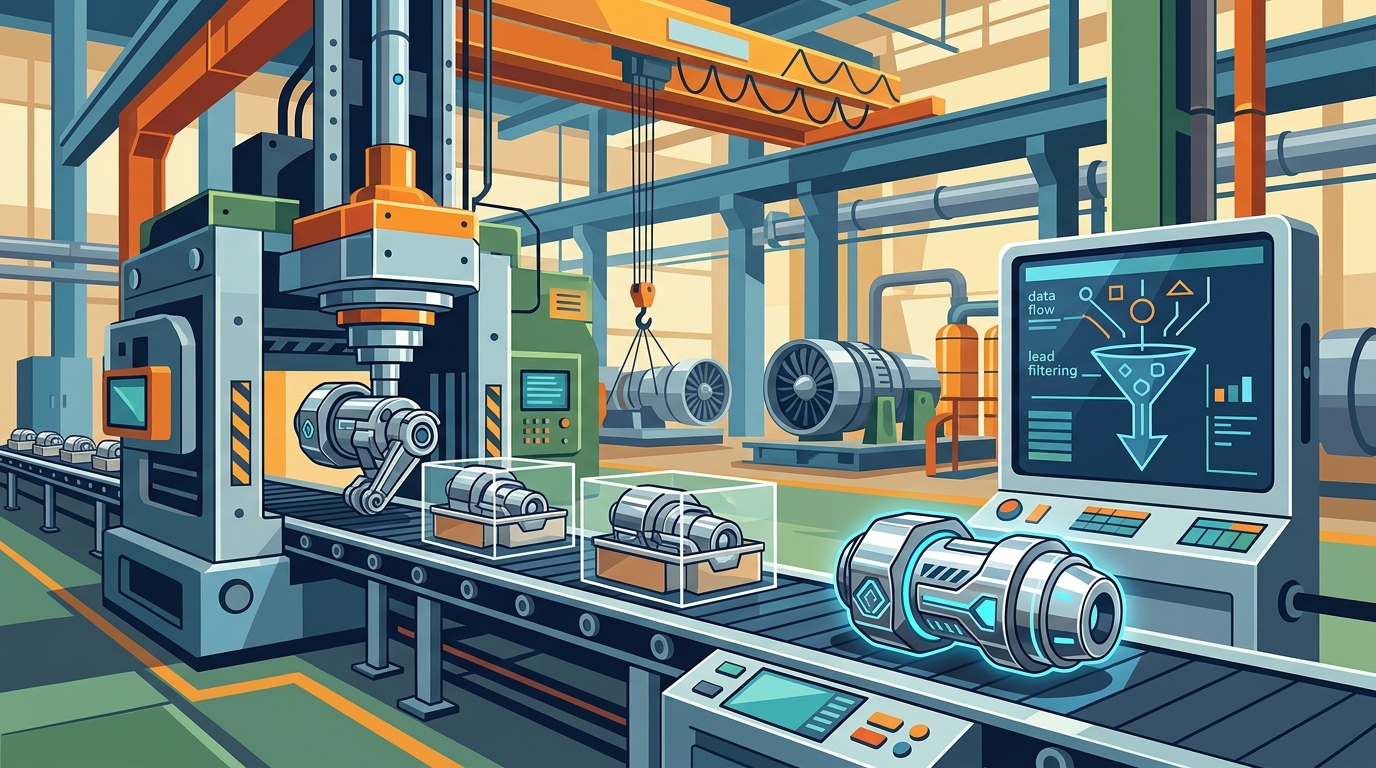
CAD files, application guides, and ROI calculators signal serious buying intent. When someone downloads your CAD model, they are actively designing your component into their assembly. Gate these high-value assets while keeping educational blog posts and FAQ pages freely accessible to build organic rankings.
Optimize for AI Search
As search engines evolve with AI-powered answer engines, structuring content with clear definitions, data tables, and direct answers to buyer questions improves visibility in both traditional SERPs and AI-generated responses. Synchronicity uses SEO-rich content strategies specifically designed for this dual-visibility approach.
Turning Your Website Into a Lead Engine
Traffic without conversion is wasted budget. Your industrial website should act like a 24/7 sales representative that guides technical buyers toward a clear next step.
Build High-Intent Landing Pages
Create dedicated pages for each application, industry, or product line. Include clear conversion paths such as RFQ forms, quote requests, and spec download buttons. A strategically designed industrial website features interactive product catalogs, user-friendly RFQ forms, and secure distributor portals built for complex buying journeys.
Prioritize Mobile and Speed
Engineers frequently pull up supplier websites on tablets and phones while standing on the plant floor. If your RFQ form breaks on mobile or your pages load slowly, you lose leads before they ever engage. Test every critical page on real mobile devices.
| Metric | Industry Average | Top Performers |
|---|---|---|
| Website Visitor-to-Lead Rate | 2-3% | 5%+ |
| Landing Page Conversion Rate | 3-5% | 8-12% |
| Average Sales Cycle Length | 6-12 months | 4-8 months |
| Marketing Budget (% of Revenue) | 2-3% | 4-5% |
PPC and Paid Advertising for Industrial Buyers
Pay-per-click advertising is a powerful complement to organic search, especially when your lead generation system is already in place. Targeted ads on Google and LinkedIn can generate leads for specific products and applications without replacing your existing referral and trade show pipelines.
The key is precision targeting. Use campaign-specific landing pages rather than sending paid traffic to your homepage. Conversion Rate Optimization (CRO) is the practice of systematically testing headlines, CTAs, form fields, and layouts to maximize the percentage of visitors who take action. Marketing consulting can help you identify which paid channels deliver the best cost per qualified lead for your industry.
AI Prospecting and Account-Based Marketing
Account-Based Marketing (ABM) is a strategy that concentrates sales and marketing resources on a defined set of target accounts. For industrial companies selling to a finite universe of OEMs, distributors, or plant operators, ABM is especially effective because it replaces spray-and-pray outreach with precision.
Modern AI prospecting tools identify accounts that match your product and show real buying intent, so your outbound efforts reach companies that are actively evaluating solutions. Synchronicity offers an AI Lead Prospecting Tool that helps manufacturing, industrial, and B2B teams surface high-fit accounts with CRM-ready handoff and pipeline reporting.
This approach complements SEO and PPC rather than competing with them. SEO and PPC capture active demand from buyers who are already searching, while AI prospecting helps you identify the right accounts sooner and create more targeted outbound and content.
Lead Qualification Frameworks That Work
Not every lead deserves your sales team's time. Without a qualification process, reps treat every inquiry the same, wasting hours on prospects who were never going to buy while letting hot opportunities go cold.
Research from Marketo shows that companies with mature lead qualification processes see 9.3% higher sales quota attainment. Start by analyzing your top 20 closed accounts. What did they have in common before they became customers? Those patterns become your qualification criteria.
Implement a lead scoring system that evaluates both fit (company size, industry, role) and intent (pages visited, content downloaded, RFQ submitted). Connect your website forms directly to your CRM so no inquiry falls through the cracks. Synchronicity integrates sites with CRM systems and marketing automation tools to track engagement and streamline the sales handoff.
Key Takeaways
- Qualified lead generation for industrial companies requires a multi-channel approach combining SEO, PPC, content, and AI-powered prospecting.
- Technical utility content (CAD files, spec sheets, application guides) outperforms generic thought leadership for attracting serious buyers.
- Your website must function as a lead engine with high-intent landing pages, clear CTAs, and mobile-optimized RFQ forms.
- Account-Based Marketing lets industrial companies focus resources on the finite set of accounts most likely to convert.
- Lead qualification frameworks prevent sales teams from wasting time on unfit prospects and improve quota attainment by nearly 10%.
- B2B companies typically invest 2% to 5% of revenue in marketing, with top-performing manufacturers trending toward the higher end.
- Sales cycles of 6 to 12 months are normal in manufacturing; plan your pipeline and attribution models accordingly.
Frequently Asked Questions
What is the best lead generation strategy for industrial companies?
The most effective approach combines SEO-driven inbound content with targeted PPC, AI-powered account identification, and a structured lead qualification process. No single tactic works in isolation; the best results come from an integrated system.
How long does it take to see results from industrial lead generation?
Expect one to two quarters before new campaigns produce closed deals. SEO efforts typically take 3 to 6 months to gain traction, while PPC can generate leads within weeks. Manufacturing sales cycles add another 6 to 12 months from first touch to closed contract.
How much should a manufacturing company spend on marketing?
B2B companies typically spend 2% to 5% of revenue on marketing, with the median around 3.4% according to Deloitte's 2026 Manufacturing Outlook. Companies in aggressive growth mode often invest at the higher end of this range.
What is a good conversion rate for an industrial website?
The average visitor-to-lead conversion rate for industrial websites is 2% to 3%. Top-performing sites with optimized landing pages and clear conversion paths can reach 5% or higher.
Should we gate all of our content?
No. Keep educational content like blog posts and FAQ pages freely accessible to build SEO rankings. Reserve gating for high-value assets such as CAD files, detailed whitepapers, and ROI calculators that signal genuine project-level interest.
How does AI prospecting differ from traditional outbound?
AI prospecting uses intent data and firmographic signals to identify accounts that match your ideal customer profile and are actively researching solutions. Traditional outbound relies on static contact lists. AI prospecting produces higher-quality conversations because it targets companies showing real buying behavior.
Do we need a new website to generate leads?
Not necessarily. Many wins come from optimizing what you already have: tightening technical SEO, improving messaging and CTAs, and adding high-intent landing pages. A full rebuild is only recommended if your platform cannot support basic performance, security, or lead capture needs.
What role does content marketing play in industrial lead generation?
Content marketing educates technical buyers at every stage of their journey. Engineers and procurement professionals research extensively before contacting a supplier. Publishing application guides, comparison charts, and technical articles positions your company as a trusted authority and drives organic traffic that converts.
Ready to Build Your Lead Engine?
If your industrial company is ready to move beyond trade show business cards and random website forms, it is time to build a repeatable lead generation system. Synchronicity's Manufacturing Lead Engine is a productized system designed for manufacturers, OEMs, and industrial suppliers that turns buyer intent into RFQs, distributor inquiries, and real sales conversations. Schedule a conversation with the Synchronicity team to see how it fits your growth goals.